

Heat transfer in slurries is difficult for reasons that have little to do with heat transfer itself. The fluid carries abrasive solids that wear through tubes and baffles, the solids settle out of suspension when velocity drops, and deposits on heat transfer surfaces reduce performance faster than in clean service. A slurry heat exchanger is therefore a design problem in materials, velocity, and geometry before it is a thermal problem.
What Makes Slurry Service Different
A slurry is a solid-liquid mixture, and its behavior depends on solids concentration, particle size distribution, particle shape, and the carrier liquid. Three consequences follow for exchanger design:
- Abrasion. Particles moving across tube surfaces remove material, and the rate depends strongly on particle size, velocity, and impact angle. Higher velocity improves heat transfer and keeps solids suspended, but it also accelerates wear. The design must find a velocity that satisfies both, and that window can be narrow.
- Settling. Below a certain velocity, solids settle in low-flow regions - in the shell, behind baffles, and in headers. Settled solids can compact and block flow passages. This sets a minimum velocity, which conflicts with the abrasion limit at the top end.
- Fouling and scaling. Deposits form on heat transfer surfaces and are harder to remove when they contain embedded solids. The thermal penalty compounds because the deposit also changes the local flow field, often creating more low-velocity regions where further deposition occurs.
Design Approaches
Different exchanger types address these problems in different ways, and the choice depends on the slurry:
-
Wide-gap or free-flow plate exchangers use wide flow channels that pass larger particles without blocking. They are cleanable by opening the plate pack but are limited in pressure and temperature.
-
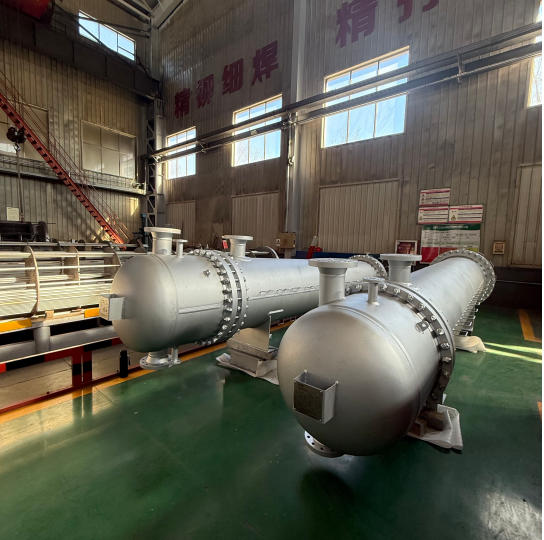
Shell and tube units with enlarged tube passages reduce blockage risk but still suffer abrasion at tube inlets, where flow impinges directly on the tubesheet. Inlet ferrules or hardened inserts are used to protect this region.
-
Spiral and helical designs avoid dead zones and maintain more uniform velocity, which reduces settling. They are often used where fouling is the dominant problem.
-
Direct-contact and fluidized-bed exchangers avoid fixed heat transfer surfaces in the slurry path entirely by transferring heat to or from solid particles or a secondary fluid. These are used where abrasion and fouling cannot be managed on a fixed surface.
-
Material selection follows from the wear mechanism. Hardfacing, ceramic linings, and hardened alloys address abrasion; stainless and duplex steels address corrosion. In many slurries both mechanisms act together, and erosion-corrosion can remove material faster than either process alone.
Selection Criteria
Specifying a slurry exchanger requires data that clean-service selection does not:
Slurry characterization - solids concentration by weight and volume, full particle size distribution (not just a mean), particle hardness and shape, carrier liquid chemistry, pH, and chloride content. A single "concentration" figure is not sufficient to predict either settling or wear.
Settling velocity - determine the minimum velocity needed to keep solids in suspension for the actual particle distribution. This sets the lower bound on flow velocity in every region of the exchanger, including headers and shell-side dead zones.
Abrasion rate versus velocity - establish the acceptable wear rate and the velocity at which it occurs for the candidate material. Together with the settling velocity, this defines the feasible velocity window.
Fouling mechanism - identify whether fouling is particulate settling, crystallization, chemical reaction, or biological. Each requires a different mitigation: velocity, surface temperature control, material choice, or cleaning method.
Cleaning method - confirm that the design allows the cleaning method planned (hydraulic, mechanical, chemical) and that access points are adequate. A design that cannot be cleaned in practice will not stay in service.
Thermal duty and pressure drop - define heat load, allowable pressure drop, and temperature approach. In slurry service the pressure drop allowance is often set by the pumping cost of a high-density fluid, so the thermal design and hydraulic design must be optimized together.
Operation and Maintenance
The operating practices that matter most in slurry service are the ones that keep velocity within its window:
Monitor flow rate continuously. A reduction in flow below the settling velocity allows solids to deposit, and restarting at design flow may not remobilize compacted solids.
Track pressure drop and outlet temperature difference. A rising pressure drop at constant flow indicates partial blockage or fouling and should trigger inspection before the unit is forced offline.
Inspect wear-prone regions - tube inlets, baffle edges, and impingement zones - at defined intervals, and record wall thickness so that wear rates can be calculated rather than estimated.
On shutdown, flush the exchanger if the slurry can settle and set. Standing slurry in a unit is a common cause of startup blockage.
Conclusion
Slurry heat exchanger performance is governed by the interaction of settling velocity, abrasion rate, and fouling mechanism, and the design must satisfy all three simultaneously. Material choice, flow geometry, and cleaning access are the levers. Selecting on the basis of a full particle size distribution, a calculated velocity window, and a defined cleaning method is what separates a unit that stays in service from one that is cleaned constantly or fails early. The technology is useful where those conditions are analyzed properly; it is not a general solution that makes slurry service behave like clean service.